


A new year begins. And with it, new possibilities. A new you. A chance to change the direction of your entire life.
Okay, let's pause. That got heavy fast.
If you’re reading this, you probably fall into one of two camps:
-
You’ve set goals before and felt fired up… and then life happened.
-
You’ve stopped setting goals because it feels like an emotional setup for disappointment.
I get it. The point of this post isn’t to hype you up. It’s to give you a simple process that stacks the odds in your favor, so you’re not relying on motivation and vibes to carry you through 2026.
Here’s the plan:
TL;DR: Mindset → Write goals → Categorize with Wheel of Life → Find blind spots.
Short on time? Take the Wheel of Life Assessment and find your blind spots first.
-
Step 1: Adopt the right mindset
-
Step 2: Write your goals down (yes, physically)
-
Step 3: Categorize your goals so you can see what you’re missing
Let’s start where most people skip: mindset.
Step 1: Adopt the right mindset (stack the odds)
The first thing I want to reassure you of is this:
You do not need to be perfect.
You just need to point yourself in the right direction.
Even the slightest adjustment you make now can lead to outsized gains over time.
Here’s a belief I’ve had for a while: life deals in probabilities. Outcomes are rarely guaranteed. Events have a greater or lesser chance of occurring. Your “job” isn’t to control everything. Your job is to increase your odds.
If you watch sports, you know this intuitively. The better team doesn’t always win. And if you’ve ever watched a Texas Hold’em tournament, you’ve seen it in a pure form: someone can be an 83% favorite and still take a bad beat. That doesn’t mean they made the wrong decision. It means… probabilities aren’t certainties.
That’s the mindset shift:
You’re not trying to guarantee success.
You’re trying to run a process that makes success more likely over time.
Be a Stoic about it:
-
Own what you can control.
-
Don’t stress about what you can’t.
-
And don’t call yourself a failure because you took a swing and missed this one time.
Your meta-goal for 2026 is to increase the surface area for luck to occur in your life by taking actions that meaningfully improve your odds.
If Step 1 is “aim yourself in the right direction,” then Step 2 is where we make it real.
Step 2: Write your goals down (make the mental, physical)
Step 2 is to take the goals floating around in your head and manifest them in the real world.
You literally want a physical artifact.
Write it down. Type it. Pin it. Put it somewhere you’ll see it.
Even if once per year you wrote down goals in your iPhone Notes, that would be progress. Even a quick Pinterest board. The point is simple:
Make the invisible visible.
When I was a teenager, I had a corkboard in my room that looked like what people now call a “dream board.” I was in community college and I wanted to transfer to UC Berkeley. I reached out and they mailed me a glossy brochure for transfer students featuring the iconic Campanile on the cover.
Inside, there was a page listing the GPA range of incoming transfer students: 3.44 to 3.88.
I ripped out that page and pinned it to my corkboard.
I couldn’t avoid it. It became front-of-mind. I’d stare at it. Refer back to it. It wasn’t motivational fluff—it was a target.
I did get accepted and attended (I didn’t graduate—more on that in another post). But that experience taught me something I still use:
Writing things down doesn’t magically make them happen.
But it does something almost as powerful: it changes what you notice, what you choose, and what you do on random Tuesdays.
Your 15–30 minute exercise (do this now)
Set a timer for 15–30 minutes. Write down a raw list of goals for 2026. Don’t overthink. Don’t edit. Let it be messy.
To give you an example, here’s what I jotted down as my first pass for 2026:
-
Register and pass with a B+ or better 4–6 accounting classes to pursue my CPA plan
-
Organize an annual road trip to Texas, Mid-Atlantic, or Southwest
-
Book a Mediterranean cruise
-
Complete at least 25 1040 tax returns for the 2026 tax year
-
Roll out a Circle community for Financial Boss and Tax Boss
-
Hire at least one part-time employee
-
Maintain my professional credentials and business licenses
-
Stay at the Thayer Hotel at West Point and shoot at the Tronsrue Marksmanship Center
-
Build two IKEA hack built-in closets for my son and daughter’s bedrooms
-
Post at least 26 videos to my YouTube channel
-
Take my wife on a romantic overnight alone trip
-
Add an additional $2,000 in MRR
-
Start my first bee colony
That list is not perfect. It’s not meant to be. It’s meant to be a raw block of unformed clay that we’ll later design into the life you want.
Once you do this, you’ll probably have questions like:
-
Am I missing goals?
-
How do I know my goals are the right goals?
-
Do I need to prioritize them?
-
Do some goals have hard deadlines?
-
Are they specific enough?
-
Can I realistically do this in one year?
-
Do I have enough money for some of these?
It’s okay to have more questions than answers at this stage. You aren’t doing anything wrong. This is how the process works for us all. Just take a moment now and congratulate yourself for taking the first step to living a life with intention.
Now we move to Step 3, which is where the fog starts to clear.
Step 3: Categorize your goals (so patterns and blind spots emerge)
To answer the first three questions (am I missing goals, are these the right goals, do I need to prioritize), I needed a rubric.
I found it in the Wheel of Life, first introduced by personal development pioneer Paul J. Meyer in the 1960s and later popularized by Zig Ziglar and many coaches since.
Some Certified Financial Planners (CFP®) like me have adapted it to integrate life planning with financial planning. The idea is simple: a fulfilling life isn’t one category. It’s a set of categories, some of which require money, some require time, and some require attention.
The classic Wheel of Life categories are:
-
Health
-
Money
-
Career
-
Home and Environment
-
Family and Relationships
-
Personal Growth
-
Fun and Recreation
-
Community and Giving
Do this with your goals
Take your raw list that you brainstormed in Step 2, and drop each item into one category.
Here’s what that looked like for me:
| Brainstorm Goal | Wheel of Life Category |
| Complete at least 4 more accounting courses to qualify for the CPA exam | Career |
| Plan the annual family roadtrip | Family and Relationships |
| Book a family Mediterranean cruise | Family and Relationships |
| Complete at least 25 paid tax returns | Career |
| Rollout an online community for Financial Boss and Tax Boss | Career |
| Hire at least one part-time employee | Career |
| Maintain professional credentials and licenses (e.g. CFP, EA, PMP, CSM) | Career |
| Visit West Point and stay at the Thayer Hotel | Fun and Recreation |
| Build two IKEA built-in closets | Home and Environment |
| Post 26 blog articles and YouTube videos | Career |
| Book romantic weekend trip with wife | Family and Relationships |
| Add $2,000 in monthly reoccurring revenue to my business | Career |
| Start my first bee colony | Fun and Recreation |
Then, I counted how many goals fell into each category, so that I could get an idea where things were clustering:
| Wheel of Life Category | Total Count | As a Percentage |
| Health | 0 | 0% |
| Money | 0 | 0% |
| Career | 7 | 54% |
| Home and Environment | 1 | 8% |
| Family and Relationships | 3 | 23% |
| Personal Growth | 0 | 0% |
| Fun and Recreation | 2 | 15% |
| Community and Giving | 0 | 0% |
| TOTALS | 13 | 100% |
That was… revealing.
It makes sense that Career would show up a lot. I’m in my forties, in the middle of peak earning years, and I’m building multiple business lines. But seeing 0% Health and 0% Community and Giving was a red flag.
And it raised two important issues:
-
Categorizing can get fuzzy. Is CPA “Career” or “Personal Growth”? Is building two closets one goal or two?
-
Sometimes your goals don’t reflect your reality. I volunteer on three boards—so how is “Community and Giving” at zero?
This is where I leaned on my old life as a product manager and my still-active PMP® / Certified ScrumMaster (CSM®) brain.
I created a simple hierarchy in my Jira board (you can do this in Excel or Notepad):
-
Epics = the 8 Wheel of Life categories (03 Career)
-
Features = sub-categories inside each one (C02 Skills and Credentials)
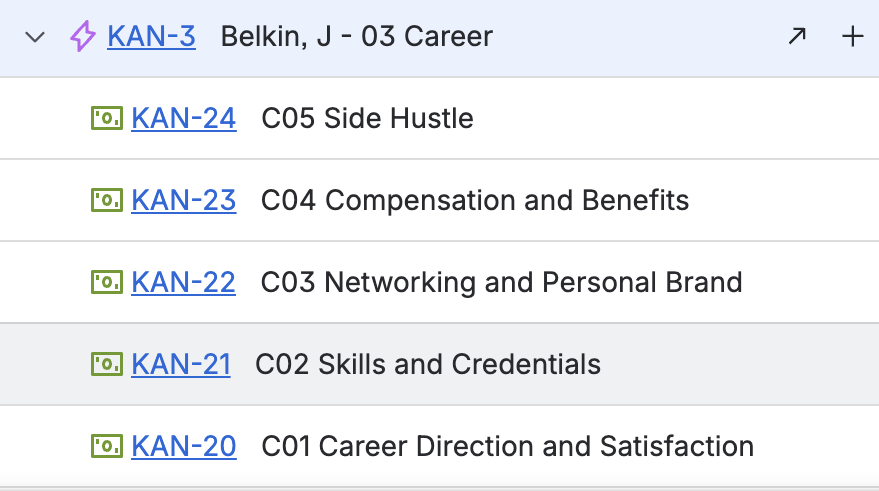
That extra detail did two things:
-
It made categorizing easier (CPA clearly fit under “Career → Skills and Credentials”)
-
It surfaced goals I wasn’t even thinking about
The missing piece: satisfaction vs. goals
Then, I made it more objective. I created a simple Wheel of Life assessment: 23 questions (Take the Wheel of Life Assessment) and scored it like this:
-
2 = Very dissatisfied
-
4 = Somewhat dissatisfied
-
6 = Neutral / OK
-
8 = Pretty satisfied
-
10 = Very satisfied
Here’s why this matters:
Sometimes you have zero goals in a category because you’re already doing great there.
Other times you have zero goals because you’re avoiding something.
In my case, the assessment made it obvious: According to my emailed results, I had no goals for the three areas I was least satisfied with:
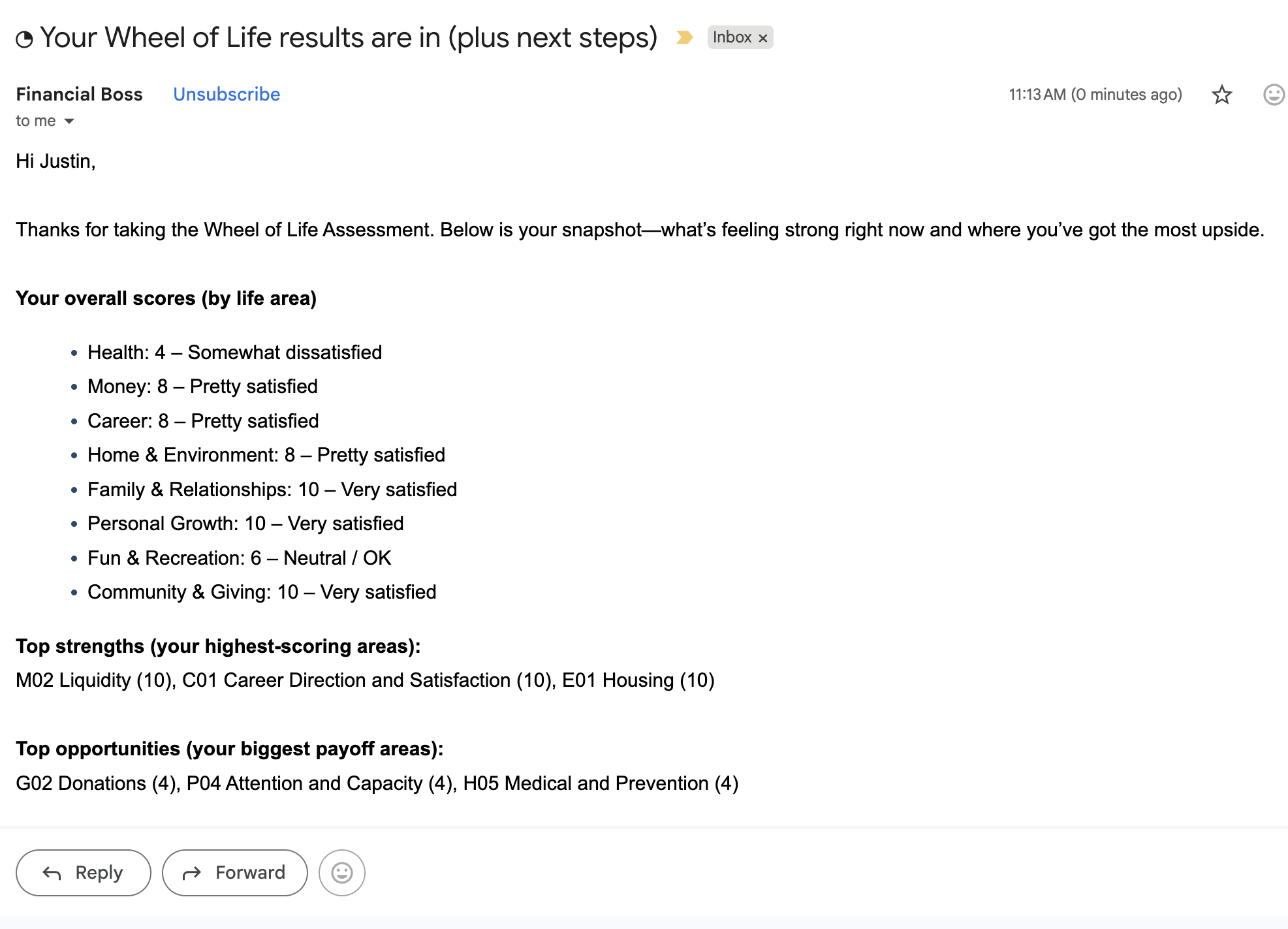
That’s the difference between what you want and what you need.
So, I added goals that actually addressed my lowest-scoring areas (aka "top opportunities"):
-
Donate to St. Jude’s, Wounded Warriors, and the ASPCA
-
Reduce iPhone screen time from 4 hours/day to 3 hours/day
-
Walk on my Peloton treadmill and lift weights at home at least 3 times/week
That felt like real progress—because it wasn’t random. It was targeted.
Where we are so far (and what’s next)
Here’s what we’ve done:
-
Step 1: Adopted the mindset of stacking odds and controlling inputs
-
Step 2: Brainstormed and wrote down goals (messy is fine)
-
Step 3: Categorized goals using the Wheel of Life and used an assessment to identify blind spots
We still have important questions left:
-
Do some goals have hard deadlines?
-
Are goals specific enough to mean anything?
-
Can I realistically achieve these in one year?
-
Do I have enough money to pursue them?
In my next post, I’m going to introduce a system that becomes your single source of truth—a way to translate goals into action using Agile ideas like Epics → Features → User Stories → Tasks, and then making tasks SMART (Specific, Measurable, Achievable, Realistic, Time-bound).
Here’s a preview of how that looks:
Epic: Community and Giving
Feature: Donations
User Story: As someone who believes in paying it forward, I want to donate to several charities that are important to me, so I can support causes I care about and model generosity for my children.
Task: By Jan 25, enroll in a recurring donation of $25/month to St. Jude, scheduled to debit on the last day of each month, and save the confirmation email/screenshot.
That’s how a “nice idea” becomes a real plan.
And that’s how you become someone who doesn’t just set goals… but finishes them.
Ready to find your blind spots? Take the assessment here.
Quick note: This is educational content, not personalized financial or tax advice. If you want help building a plan that fits your specific situation, reach out.
Share this

Best System for Executing Your Goals in 2026

FAFSA, Tuition Bills, and the Real Cost of College Decisions

No Comments Yet
Let us know what you think